

Patients, practice teams, and dental chairs are the foundations of great dentistry. Then, other elements of care enter the fray, as a good practice needs imaging systems to support their workflows, a detailed record keeping system to safely manage patient information, and the support of a waste management service to collect the waste produced through the giving of clinical care.
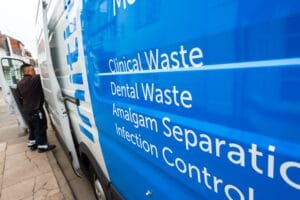
However, a specialist waste management service shouldn’t just collect your waste items. Instead, they should be able to support your practice in a number of ways, from helping you understand current guidelines, and giving advice on waste segregation, to providing appropriate complaint waste storage containers and layout solutions for your practice.
Insights on paper
Waste management workflows in general health and dental care follow the guidance in Health Technical Memorandum 07-01 (HTM 07-01). This framework helps healthcare waste producers meet legislative, technical and policy requirements, whilst reflecting key principles for sustainable workflows – including improved environmental protection, social outcomes, and reduced carbon emissions.[1]
The NHS Clinical Waste Strategy, built to steer decisions at a nationwide level, features a number of priorities and principles that can be applied to every dental practice’s waste strategy. One element is investing in a skilled workforce, and HTM 07-01 interprets this by suggesting NHS England shares knowledge and best practice with others, whilst also seeking specialist advice where it is needed.1
The dental practice’s relationship with a waste management provider can work in the same way; through collaboration and the sharing of information, dental teams and waste management services can change the way they work for the better, whether for streamlined protocols or more environmentally-friendly actions.
Seeking out expert advice is reinforced further throughout HTM 07-01, including with waste consignment notes. Used as part of the control system for hazardous waste,[2] consignment notes are the legal responsibility of a waste producer (the dental practice), but advice from a waste contractor is indicated as appropriate in many instances.1 Clinicians could also seek advice for other administerial and equally important tasks, such as waste pre-acceptance auditing. Guidance from specialists on subjects such as this ensures practices continue to follow regulations to the letter, and ensures individuals are kept abreast of any changes to disposal guidelines.
Practical changes
Waste management experts will often be able to provide advice based on their extensive knowledge of workflows in other practices, and similar healthcare providers, such as GP clinics or hospitals, which will require hazardous waste handling in a similar manner. This experience makes them ideally placed for guidance in workflow and waste container layout changes in the dental practice, as they understand the technical needs that healthcare professionals must meet.
As seen throughout HTM 07-01, dental professionals must have clinical waste containers located at points of use, as well as larger bulk containers for storage in safe areas, away from patients and public spaces.1 This includes specific bins for safer sharps disposal, to protect the dental team, patients and waste handlers. A specialist waste management service will be able to identify where potential issues could arise, such as improperly positioned or maintained storage, and provide alternative solutions. This could be in the form of actionable changes on the spot, or advice for different containers or solutions that can be delivered to the practice.
Working with a partner that is also a supplier of such solutions can simplify these steps. It ensures any changes enacted by clinicians can be completed without having to reach out to multiple different services, saving time that can be better spent providing leading patient care.
However, dental professionals should be confident that their chosen partner is a reliable source for advice, practical solutions and waste collection. Ensure your service is registered with the Environment Agency to legally transport or dispose of waste, or act as a broker, and has appropriate accreditation in place for providing clinical waste solutions.
Support you can trust
When looking for regulatory guidance and practical waste management support in your practice, choose Initial Medical. With half a century of expertise managing hazardous waste, the Initial Medical team can provide unique insights into your own workflows, with support for effective changes that can be made.
Our free clinical waste compliance audit survey will assess each step of your waste management process and identify areas where attention is required. Initial Medical is also well positioned to support your needs as a waste handler and provider of regulatory-compliant, colour-coded hazardous waste containers.
A waste management service can do more than collect your waste items, unlocking the full potential of a service begins with simple questions, and an effective partnership can blossom.
To find out more, get in touch at 0808 304 7411 or visit the website today www.initial.co.uk/medical

Author: Rebecca Water
About Initial Medical
Initial Medical set the standard in healthcare and infectious waste management in the UK, providing a reliable, effective and fully compliant service built around customer needs and delivered by our highly trained local teams. We are ISO 9001:2015 accredited, with technology fully integrated into our operations, providing full traceability of service delivery, electronic waste documentation and the best customer experience possible. We also offer innovative healthcare waste management services and infection control products to help break the chain of transmission and prevent cross contamination.
Initial Medical are a company with a ‘World Class’ Health and Safety record, and ISO 45001:2018 accreditation. We are also accredited to ISO 14001:2015 environmental standards and pride ourselves on our sustainable approach with a focus on delivering eco-friendly products and operational solutions.
Media enquiries:
For more information, please contact:
01227 265700
[1] NHS England, (2023). Health Technical Memorandum 07-01: Safe and sustainable management of healthcare waste. (Online) Available at: https://www.england.nhs.uk/wp-content/uploads/2021/05/B2159iii-health-technical-memorandum-07-01.pdf [Accessed September 2025]
[2] Environment Agency, (2019). Hazardous waste: consignment note guidance. GOV.UK. (Online) Available at: https://www.gov.uk/guidance/hazardous-waste-consignment-note-supplementary-guidance [Accessed September 2025]