

Dental care is critical to the wellbeing of an individual, whether an ailment is identified and intercepted before significantly impacting everyday life, or a restoration is provided to alleviate a long-standing issue. The worst-case scenario for any form of treatment is for care to exacerbate a problem or create a new cause for concern.
Healthcare associated infections (HCAIs) are one potential result of treatment in both dental and general healthcare. The pathways of contamination are bidirectional, with the opportunity for infection to be transferred from the patient to members of the dental team, but also from the clinician to the individual in the dental chair.
Understanding risks for HCAIs allows clinicians to revisit their workflows and make effective changes that support the safety of patients and the dental team.
Current impact
The most recent figures for HCAIs in the UK come from a 2023 report, which found that 7.6% of all treated patients (across general healthcare) were affected.[i] This was a 1% increase on the previous findings from 2016.1 The impact can be detrimental; infection leads to longer treatment times, the potential for extended hospital stays and, in the most extreme cases, risk to life.
The NHS has consistently felt the strain of such pressures. In 2020, the cost placed upon the health service from HCAIs was approximately £2.7 billion annually, accounting for 834,000 infections and 28,500 deaths – patient management and extended hospital stays accounted for most of this expenditure.[ii]
Before delving into how to anticipate HCAIs, it’s important to first recognise that prevention isn’t a fruitless task. The European Centre for Disease Prevention and Control estimates that up to 50% of HCAIs are preventable.[iii]
Finding risks
HCAIs can be caused by viruses, bacteria and multi-resistant bacteria.[iv] Most specific diseases will be associated with a virus, as bacterial transmission does not often result in infection, but clinicians still need to be aware of the potential for harm.
Legionella spp. and Pseudomonas aeruginosa have been linked to potential infections in the dental practice, with both bacteria able to survive in contaminated dental unit waterlines.4 Cases of infection from dental practices are sparse, but not unheard of. Legionnaires’ disease, from the Legionella spp. bacterium is considered to be a significant HCAI, as about 11.5% of reported cases between 1980 and 2009 in the UK were hospital-acquired.4
Safe dental waterline microbial control includes the use of distilled or RO water, disinfectants and antimicrobial agents, as well as monitoring water quality and regularly flushing waterlines with air or water to avoid stagnation and biofilm build-up.[v]
To avoid the transmission of viruses, everyone involved in providing care should be trained in hand decontamination, the use of personal protective equipment (PPE) and the safe use and disposal of sharps.[vi] Effective hand hygiene processes are imperative, especially when treating multiple patients.
The World Health Organisation (WHO) finds that appropriate hand hygiene prevents up to 50% of avoidable HCAIs.[vii] Liquid soap should be used at regular points throughout the workflow, including before and after each treatment session, before and after the removal of PPE, and before contact with instruments that have been steam-sterilised.
Sharps management
In dentistry, saliva and blood are prominent sources of infection, and bloodborne contamination is a high risk when an individual suffers a percutaneous injury. They are not uncommon, as around 51% of dental nurses have experienced an inoculation injury at least once, according to a 2025 survey.[viii]
Protocols in place to prevent injury, such as not recapping needles, are key. So too is sharps waste management – the most common stage of the workflow for an inoculation injury is after use, but before disposal.8 Clinicians must have access to sharps waste containers close to the point of use. If the sharp is contaminated, for example, by a blood-borne virus when treating a patient with human immunodeficiency virus (HIV). Immediate access to an appropriately colour-coded waste container is also imperative in minimising risks.
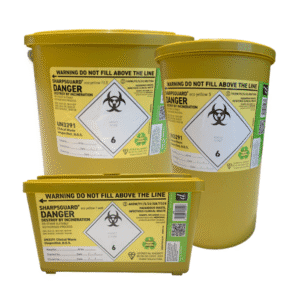
Sharps bins from Initial Medical are designed for the safe classification of hazardous materials, whilst providing protection against percutaneous injury. They are available in a range of sizes and capacity variations, enabling clinicians to store waste created chairside, with point-of-use disposal trays available. They are colour-coded to keep in line with Health Technical Memorandum 07-01. You can also access free downloadable colour code posters on the Initial Medical website.
Understanding how HCAIs can occur is vital for dental professionals to know. Clinicians can then reflect on their workflows and ensure that they are as safe as possible for both patients and the dental team. Paying extra attention to sharps waste management is paramount to minimising risks, no matter how unlikely they may seem.
To find out more, get in touch at 0808 304 7411 or visit the website today www.initial.co.uk/medical
 Author: Rebecca Waters
About Initial Medical
Initial Medical set the standard in healthcare and infectious waste management in the UK, providing a reliable, effective and fully compliant service built around customer needs and delivered by our highly trained local teams. We are ISO 9001:2015 accredited, with technology fully integrated into our operations, providing full traceability of service delivery, electronic waste documentation and the best customer experience possible. We also offer innovative healthcare waste management services and infection control products to help break the chain of transmission and prevent cross contamination.
Initial Medical are a company with a ‘World Class’ Health and Safety record, and ISO 45001:2018 accreditation. We are also accredited to ISO 14001:2015 environmental standards and pride ourselves on our sustainable approach with a focus on delivering eco-friendly products and operational solutions.
Media enquiries:
For more information, please contact:
01227 265700
[i] UK Health Security Agency, (2025). UKHSA publishes latest survey on healthcare-associated infections. GOV.UK, (Online). Available at: https://www.gov.uk/government/news/ukhsa-publishes-latest-survey-on-healthcare-associated-infections [Accessed August 2025]
[ii] UK Health Security Agency, (2025). Point prevalence survey on healthcare-associated infections, antimicrobial use and antimicrobial stewardship in England, 2023. (Online) Available at: https://assets.publishing.service.gov.uk/media/6827325d010c5c28d1c7e728/HCAI-AMU-PPS-2023-report.pdf [Accessed August 2025]
[iii] European Centre for Disease Prevention and Control, (N.D). Healthcare-associated infections. (Online) Available at: https://www.ecdc.europa.eu/en/healthcare-associated-infections [Accessed August 2025]
[iv] Laheij, A. M. G. A., Kistler, J. O., Belibasakis, G. N., Välimaa, H., De Soet, J. J., & European Oral Microbiology Workshop (EOMW) 2011. (2012). Healthcare-associated viral and bacterial infections in dentistry. Journal of oral microbiology, 4(1), 17659.
[v] Department of Health, (2013). Health Technical Memorandum 01-05: Decontamination in primary care dental practices. (Online) Available at: https://www.england.nhs.uk/wp-content/uploads/2021/05/HTM_01-05_2013.pdf [Accessed August 2025]
[vi] National Institute for Health and Care Excellence, (2017). Healthcare-associated infections: prevention and control in primary and community care. (Online) Available at: https://www.nice.org.uk/guidance/cg139/chapter/Key-priorities-for-implementation [Accessed August 2025]
[vii] World Health Organization, (2021). Key facts and figures, World Hand Hygiene Day 2021. (Online) Available at: https://www.who.int/campaigns/world-hand-hygiene-day/2021/key-facts-and-figures [Accessed August 2025]
[viii] Based on an independent study conducted with dental professionals, Initial Medical internal data.