


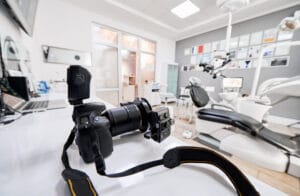
There is power in an image. Everyday life has become increasingly visual: from phone calls to podcasts, adverts to social media, everything now has to be visually appealing. In this eye-popping landscape, words no longer have the same sway; if the brain processes images and colours faster than it does sentences, why wouldn’t businesses harness the power of photography and videography to enhance their marketing?
Alongside function, imagery and aesthetics sit at the centre of cosmetic dental treatments, offering visually appealing possibilities for patients dissatisfied with their smile. Cosmetic dentists looking to attract new patients should promote the aesthetic quality of their work with consistent, high-quality clinical photography; a small aspect of each appointment that can have a massive impact on the overall workflow of the practice.
Visual aid for better communication
High quality images provide a clear and impactful aid to improve patient communication. For cosmetic dentists, some patients may arrive at the dental practice with a fully formed idea of what treatment they want based on what they have seen elsewhere. However, an assessment of their dentition may reveal that their desired treatment is not in their best health interests – this can lead to dissatisfaction for the patient. Clinical photographs are an excellent way to navigate this as dentists can effectively show the issues or sources of potential complications in the patient’s oral cavity. From misalignments to gingival recession or tooth decay, being able to highlight any limitations with visual proof can improve the patient’s acceptance that their idealised treatment is not feasible. Similarly, using clinical photographs can help dentists explain alternative treatments that are more appropriate, and can also motivate oral hygiene habits for the patient.
Each cosmetic dental treatment should, therefore, be meticulously photographed to best capture the aesthetic improvement, enabling the dentist to share their work with both future patients and other dental professionals. These photographs are also an essential part of record-keeping, providing legal protection for the dentist.
It has also been found that the inclusion of a photograph with a referral can enhance written content – cosmetic dentists may then act appropriately and safely with the extra visual detail.[i] If needing to refer a patient for a particularly challenging treatment, the more photographs that can be shown to the referral dentist, the better.
Boost credibility
Besides the patient benefits, high-quality clinical photographs are great to share with other dentists. If unsure on a treatment, troubleshooting a case with a fellow professional can illuminate the next best steps. Detailed images provide a comprehensive look at a patient’s oral cavity, giving a mentor or colleague the firmest understanding of the difficulty being faced. The crisper the image quality, the easier it is for colleagues to zoom in, edit and even annotate, allowing more comprehensive feedback that accounts for all the details of the treatment. Better treatment outcomes can then be achieved.
For dentists looking to share their work through case studies, consistent photography visualises the whole journey. Again, the higher quality the images, the easier it will be for sending to the publishers and maintaining the clarity once printed in dental magazines, journals or research papers. These images are immediately more eye-catching than text alone, allowing the case studies to stand out. Sharing recent treatments is an excellent way for dentists to platform their clinical skills and get their name and practice out into the industry – it may be then that other dentists will seek their advice with similar treatments, increasing their network of contacts in the process.
Camera choice
The variety of professional cameras on the market is expansive. Dentists may opt for mirrorless cameras for their easier handling and advanced autofocus systems, making them effective for intraoral and extraoral shots, or DSLR cameras for greater lens selection and image quality.
To help dental practitioners with purchasing a new camera, the British Academy of Cosmetic Dentistry (BACD) has a rewarding connection with Canon, offering its members superb promotions and discounts every month with one of the leading photography brands. At reduced costs, BACD members can access high-quality camera equipment, optimising their workflow and ensuring that the aesthetic outcomes are captured to the highest standard.
As cosmetic dentistry is so rooted in aesthetic value, dentists should capitalise on marketing trends by showcasing their work through high-quality clinical photography. Not only does it promote treatments, but it is an invaluable tool for patient education, professional discussion and self-promotion.

For further information and enquiries about the British Academy of Cosmetic Dentistry visit www.bacd.com
[i] Webb, L.R., Simms, M.L. and Atkin, P.A. (2024). Inclusion of clinical photographs with general dental practitioner electronic referrals of patients with oral mucosal disease to secondary care: a service review. BDJ. [online] doi:https://doi.org/10.1038/s41415-024-7608-0.
Author: Dr. Carol Somerville President of BACD
 Dr. Carol Somerville Roberts BDS (Bristol 1996), MFDS RCS (Edin) 2001 is Founder and Clinical Director of Evolve Dentistry in Portishead, near Bristol—established in 2009. A highly respected practitioner in cosmetic and restorative care, she is renowned for her patient‑centred approach and meticulous attention to detail, creating a calm, trust‑based environment. Carol holds a PGCert in Non‑Surgical Facial Aesthetics (Salford University, 2020) and continually invests in professional development. A dedicated member of the British Academy of Cosmetic Dentistry (BACD) since 2008, she joined its Board in 2019, served as Vice President, and now holds the role of President‑Elect. Her mission is to deliver clinical excellence and empower patient choice in every treatment.