


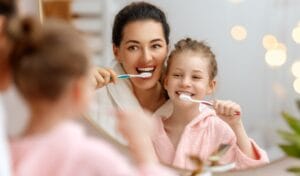
Dental caries continues to dominate concerns surrounding children’s oral health, with early onset often growing into lifelong oral health problems. Despite this, many children still fall short of achieving ideal oral hygiene due to a lack of supervision and proper education. Encouraging – and sometimes convincing – children to brush their teeth can be a tedious chore, which is why education around the topic is vital.
Implementing good oral hygiene habits from an early age is crucial. It supports the health and hygiene of their current teeth and encourages habits that will carry into adulthood. Parents can correct techniques and assist in maintaining consistency.
The significance of supervision
One of the easiest ways to encourage good habits is through supervised brushing – establishing a fun environment for children to see past the chore-like nature of brushing teeth. This can involve many different methods to succeed: tailoring the daily act to the child and reiterating the importance gently can create this setting that children find themselves genuinely enjoying.
Research indicates that children under the age of seven often lack the necessary motor skills to effectively brush their teeth. Supervision ensures that all the requirements of successful plaque removal are met, such as confirming the recommended brush-time of two minutes, and that all surfaces are covered, including the gumline and molars.
Technique to tools
Furthermore, guidance on effective brushing techniques extends to the tools used too. Support covers educating children on the correct amount of toothpaste, and helping them navigate different brush types and techniques to avoid causing damage to gums or enamel whilst still removing plaque. Each of these reiterations can significantly improve the quality and consistency of this routine, with gentle corrections to maximise the extent to which these habits are upheld. Additional methods of holding children’s attention whilst cleaning their teeth is by implementing music or games into the regime. A 2024 scoping review found that incorporating game-like elements such as rewards and challenges significantly boosted children’s enjoyment and motivation during oral hygiene routines.[i]
Though implementing successful cleaning regimes can help develop independence in toothbrushing, the consistency must be maintained as they age. Children can become overconfident in their independence which could lead them to stop adhering to proper practices. Childhood and adolescence are the most influential stages for developing healthy behaviours.[ii]
The role of schools and community programmes
Schools and education systems hold a critical role in promoting oral hygiene practises for children, providing foundations, resources, and even interactive learning. One systematic review highlights that the commitment of school staff is integral for both the implementation and continuation of supervised toothbrushing techniques. The review notes that incorporating oral health education into the curriculum enhances long-term understanding.[iii] As of March 2025, the government is investing £11 million into local authorities across England to deliver supervised toothbrushing programmes in schools and nurseries that wish to participate.[iv] This support augments dental care and hygiene in children immensely.
Additionally, community participation such as that of trained volunteers or dental hygienists can also promote a supportive environment and reinforce oral health education through peer-led and culturally tailored delivery methods. With trained dental staff and dental hygienists delivering strong messages and recommending appropriate products, school-based interventions have huge potential to dramatically improve both knowledge and frequency surrounding toothbrushing. One controlled trial showed oral health education introduced at an early age significantly increased brushing frequency.[v]
Selecting appropriate products for children
Children’s reluctance to engage with these routines can be derived from: discomfort in the act of brushing, lack of understanding of the importance of oral hygiene, and even distaste for the toothpaste used. In one particular study, of 787 5-12 year old children surveyed, 80% stated that they would prefer toothpaste flavour options other than mint-flavoured.[vi] Hence, it is important to note that the choice of oral care products can be just as influential as behavioural strategies in improving engagement and effectiveness.
Establishing an engaging oral hygiene environment relies on overcoming all potential inhibitions, with particular avoidance of any unnecessary discomforts that children may face when navigating this new experience in their lives. BioMin® F for Kids is a great example of a product that can be used to improve brushing experience and encourage participation in a once-monotonous activity. Its enticing strawberry flavour encourages not only willingness, but excitement to brush teeth.

BioMin® F for Kids is tailored to meet the needs of young teeth, containing a lower level of fluoride (530ppm), to work in harmony with developing enamel. Its patented mineral release technology, delivers a steady and responsive supply of vital mineral ions over 10-12 hours after brushing. Rather than being washed away like conventional toothpastes, BioMin® F for Kids guards young teeth against acid attacks caused by frequent snacking and sugary drinks, working long after they’ve run off to play.
Founding effective oral habits
Supervised toothbrushing is not only effective, but a vital strategy for both improving current oral health and implementing healthy, long-lasting routines. When home engagement is combined with community initiatives and appropriate toothpaste selection, the risk of potential caries and dental complications are minimised extensively.
The science is clear. The solution is simple.

www.biomin.co.uk
Calling all dentists! Do you want samples or a practice visit? Speak to our UK dealers, Trycare on 01274 88 55 44 or email: dental@trycare.co.uk, or CTS on 01737 765400 or email: sales@cts-dental.com
 Author: Alec Hilton – CEO BioMin Technologies Ltd
[i] Moreira, R., Silveira, A., Sequeira, T., Durão, N., Lourenço, J., Cascais, I., Cabral, R. M., & Taveira Gomes, T. (2024). Gamification and Oral Health in Children and Adolescents: Scoping Review. Interactive journal of medical research, 13, e35132. https://doi.org/10.2196/35132
[ii] World Health Organisation. WHO information series on school health— oral health promotion: an essential element of a health-promoting school. Geneva; 2003. https://apps.who.int/iris/bitstream/handle/10665/ 70207/WHO_NMH_NPH_ORH_School_03.3_eng.pdf?sequence=1&isAll owed=y
[iii] Chandio, N., Micheal, S., Tadakmadla, S.K. et al. Barriers and enablers in the implementation and sustainability of toothbrushing programs in early childhood settings and primary schools: a systematic review. BMC Oral Health 22, 242 (2022). https://doi.org/10.1186/s12903-022-02270-7
[iv] Department of Health and Social Care, Department for Education, Morgan, S., & Kinnock, S. (2025, March 7). Supervised toothbrushing for children to prevent tooth decay. GOV.UK. https://www.gov.uk/government/news/supervised-toothbrushing-for-children-to-prevent-tooth-decay
[v] Damle, S. G., Patil, A., Jain, S., Damle, D., & Chopal, N. (2014). Effectiveness of supervised toothbrushing and oral health education in improving oral hygiene status and practices of urban and rural school children: A comparative study. Journal of International Society of Preventive & Community Dentistry, 4(3), 175–181. https://doi.org/10.4103/2231-0762.142021
[vi] Choudhari, Sahil & Gurunathan, Deepa & Kanthaswamy, AC. (2020). Children’s perspective on color, smell and flavor of toothpaste. Indian Journal of Dental Research. 31. 338. 10.4103/ijdr.IJDR_363_18.